
Date: Thursday, March 19, 2026
Time: 6:00 PM EDT
Format: In-person
Location: Center for Hellenic Studies, 3100 Whitehaven St. NW, Washington, DC 20008
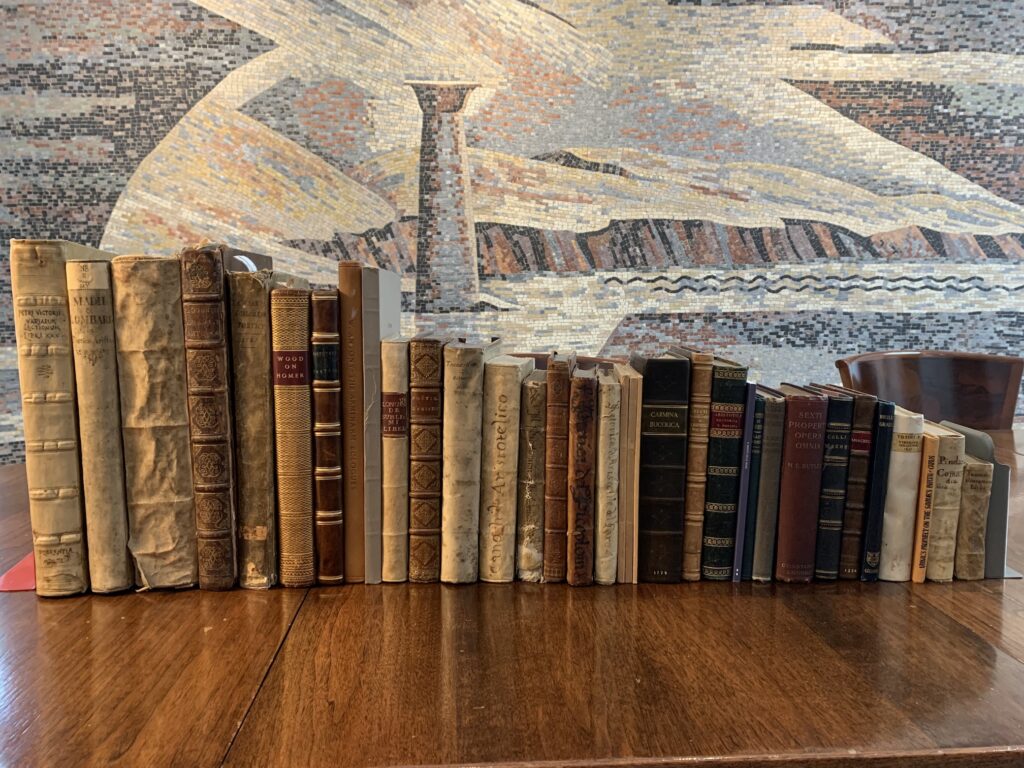
Join the CHS Library as it celebrates a collection of rare books generously donated by John Van Sickle (CUNY Brooklyn College). Anthony Grafton (Princeton) and Deborah Blocker (Berkeley) will discuss these books and guide the audience through the materials.
Presentations
John Van Sickle
“John Van Sickle Recalls.”
Introductory remarks on the collection.
Déborah Blocker
“Aristotle’s Poetics in the Van Sickle Collection: André Dacier’s Translation and Commentary (1692).”
The presentation will open with general remarks on the transmission of Aristotle’s Poetics, as reflected in the Van Sickle Collection, drawing on several volumes that will be on display. This overview will be followed by a brief case study of André Dacier’s 1692 French translation and commentary. Dacier’s Poétique d’Aristote, published “avec des remarques”, has received relatively little scholarly attention, yet it offers valuable insights into the creation of new readerships for Aristotle’s text — and into the evolving position of the “critic”. By combining a learned philological/philosophical approach with an effort to fashion a poetics accessible to cultivated but non-specialist readers, Dacier’s work helps illuminate the role such publications played in shaping the cultural authority and appeal of Aristotle’s Poetics in the early modern period. Dacier’s text and his trajectory as a scholar also exemplify the role played by political patronage in this process.
Anthony Grafton
“Some Monuments and their Meanings: The Van Sickle Donation and the History of Classical Scholarship.”
The wonderful books, ancient and modern, that John Van Sickle has given to the Center for Hellenic Studies can be read in many ways. Some of them were composed by scholars who are still known in the history of classical scholarship—from Henri Estienne and Pier Vettori, more recognizable as Henricus Stephanus and Petrus Victorius, to Robert Wood and Ulrich von Wilamowitz-Moellendorf. To hold the books is to gain a flavor—and sometimes to get hooked on the challenge—of these scholars. Some of them, like Fulvio Orsini’s book, exemplify transformations in the practice of classical philology—in his case, the origins of the comparative study of Virgil and his Greek sources which would develop over centuries to come. Still others—such as the works of Giulio Cesare Scaligero and Matthew Arnold–illustrate larger stories about classical literature and its afterlife. A few others are mysterious—and perhaps to all likely readers except John Van Sickle. No ancient writer is more prominent in this collection than Aristotle. After looking very briefly at some highlights of the collection, this lecture will discuss what these books can teach us about the culture of sixteenth century Europe, a world in which scholarship and literature, philosophy and philology regularly intersected and interacted.