
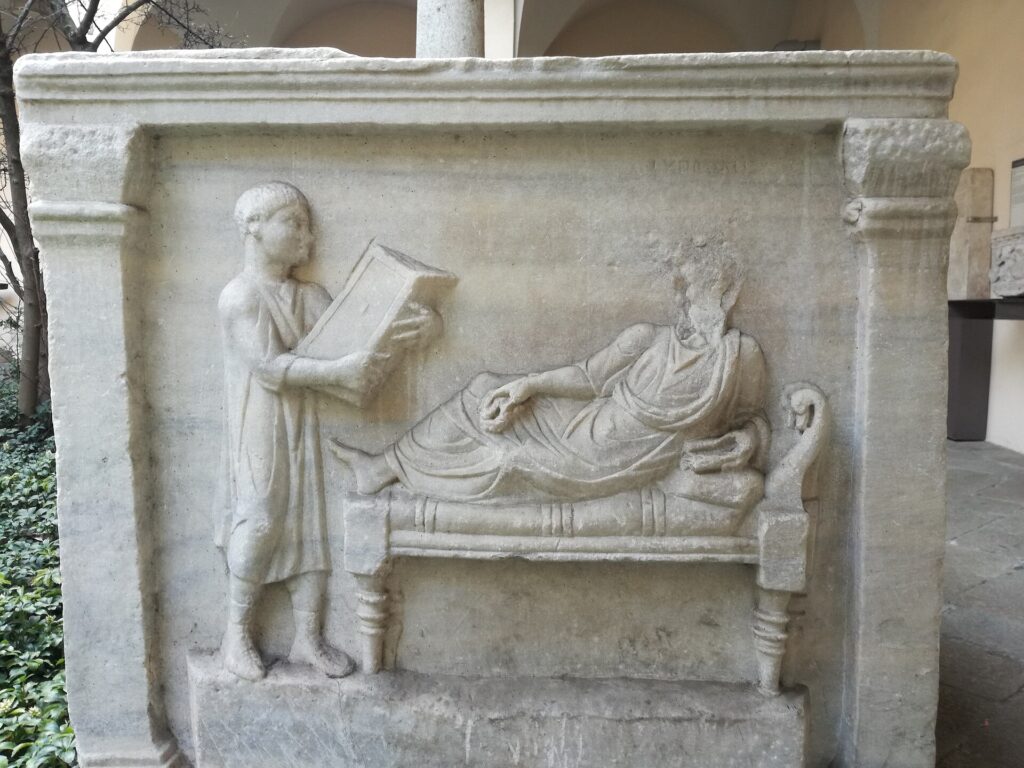
Enslaved Readers and Performers in the Greek and Roman Worlds
This event is by invitation only. Interested members of the public are welcome to attend a public-facing plenary session on Friday, February 27, from 3:30–5:30 p.m.. See details below.
Date: Thursday, February 26 – Saturday, February 28
Spanning two full days, this workshop asks how our interpretation of Greek and Roman literary texts might change when we imagine them performed aloud by enslaved readers. Within imperial literary culture, educated and wealthy elites often “read with their ears” (Starr 1990), listening to enslaved or formerly enslaved lectores and lectrices who brought texts to life with their voices and presence. Though cultural historians have long recognized the centrality of lectores (also called anagnostae) to the elite experience of reading, the performances of these figures have rarely factored into the hermeneutics of literary-critical scholarship, which tends to privilege the written text as the default point of contact between author and reader. Spotlighting instead “the immanent and invisible presence” (Howley 2020) of enslaved lectores mediating encounters between imperial elites and their books, this workshop challenges participants to experiment with reframing Greco-Roman literary texts as scripts that may have been read aloud by human beings coerced to do so. The workshop asks what happens—in the text, in the room, and in the reader—when the literary voice of a given author takes over the voice of an enslaved reader, and vice versa.
This conference will pursue an experimental, collaborative workshop format. Instead of asking participants to prepare traditional papers, invited participants will meet in small groups for collective reading, discussing, brainstorming, and writing, concluding with final presentations and discussions. By dedicating sessions to synchronous collaboration and experimentation, this workshop attempts to respond to the challenge of operating in speculative and imaginative modes that go beyond the bounds of what we “can know” and exceed the expertise of any single scholar.
Due to its format, this collaborative workshop is open only to invited participants. However, it will feature a plenary session on Friday, February 27, 3:30–5:30 p.m., that is open to the public. During this plenary session, teams of participants will present their readings and lay the groundwork for public discussion of the challenges and opportunities that arise from prioritizing the experience of non-elite readers in the hermeneutics of Greek and Roman studies.
Organizers
Niek Janssen
Christopher Londa
Nandini Pandey
Participants
Katie Dennis
Tom Geue
Chiara Graf
Joseph Howley
Miriam Kamil
Talitha Kearey
Irene Peirano Garrison
Patrice Rankine
Ryan Warwick
Thumbnail
Sarcofago milano by Fontema [CC BY-SA 4.0] via Wikimedia Commons.